


Why Look at Botty Reviews Instead of the Marketing Pitch
Official materials explain how a platform is designed to work, while user reviews help show how its features are experienced in practice. For this article, a sample of independent reviews of Botty was collected from open review platforms and public review sites across the internet in Ukrainian, Russian, and English. They were not selected or provided by the company itself, and the analysis below draws on what these users wrote about their own experience.
Reading through this sample of Botty reviews, a fairly consistent picture starts to form, not because every review says the same thing, but because certain themes keep resurfacing across otherwise unrelated authors: night-shift nurses, retired teachers, skeptical crypto veterans, and cautious first-time users. This article organizes the analysis around those recurring patterns rather than walking through a generic list of platform features.
The review sample represents individual experiences rather than a controlled study or a comprehensive survey of the platform’s entire user base. Its value lies in the recurring themes that appear across independently written accounts, including automation, emotional discipline, straightforward setup, transparent analytics, and the non-custodial connection model.
The Recurring Theme in Botty Reviews: Taking Emotion Out of the Trade
If there is one idea that appears more often than any other across this set of Botty reviews, it is not a feature or a profit figure. It is relief from emotional decision-making. Reviewers describe years of panic-selling during dips and buying tops out of fear of missing out, and they frame the bot less as a profit machine and more as a way to remove themselves from the decision loop. One reviewer, active in crypto since 2019, put it directly: the single biggest thing the bot fixed was not the market, it was their own psychology, describing years of fine entries ruined by panic-selling every dip and revenge-buying every pump.
This is not an isolated sentiment. Multiple reviewers, independently and in different wording, describe the same arc: skepticism formed by earlier losses attributed to fear and greed, a cautious initial approach used to test the bot rather than trust it outright, and a gradual shift toward confidence as trades closed without requiring manual intervention. One reviewer who admitted to overtrading out of boredom said handing execution to the bot fixed the problem overnight, adding that the strategy had been fine all along and they themselves had been the issue.
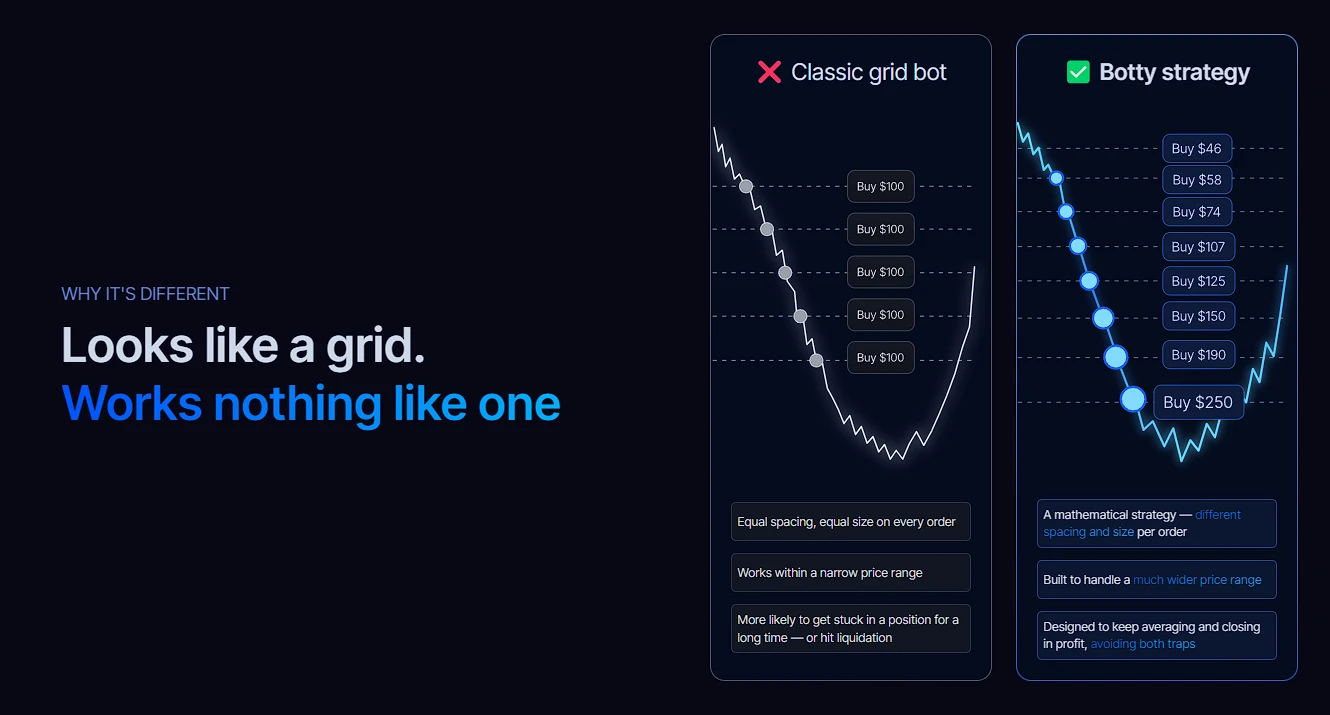
This pattern matters for understanding why Botty reviews so often frame the bot as an “autopilot” rather than a prediction engine. Several reviewers explicitly reject the idea that the bot is a shortcut to guaranteed profit, describing it instead as a tool that executes a predefined plan without hesitation, fear, or greed. That distinction recurs often enough in this sample to be treated as a genuine theme, though it remains a subjective interpretation offered by users rather than a measurable outcome.
Botty Reviews on the Initial Setup
A second recurring theme in the reviews concerns how quickly people were able to go from creating an account to having a bot configured. Several reviewers describe the process as relatively fast: choosing a preset template, connecting an exchange account through a wallet signature, and launching the selected strategy. One review describes completing the setup during a lunch break, while another says the process took less time than expected. A user who had tried three other platforms before Botty specifically contrasted the experience, saying that the earlier platforms buried the important setup steps while Botty labeled the available options clearly.
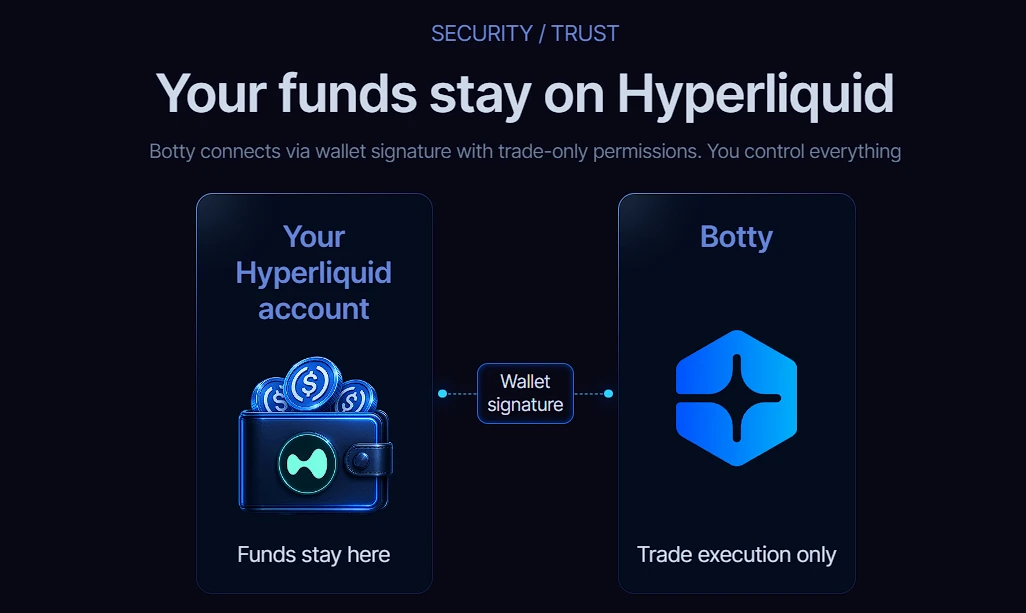
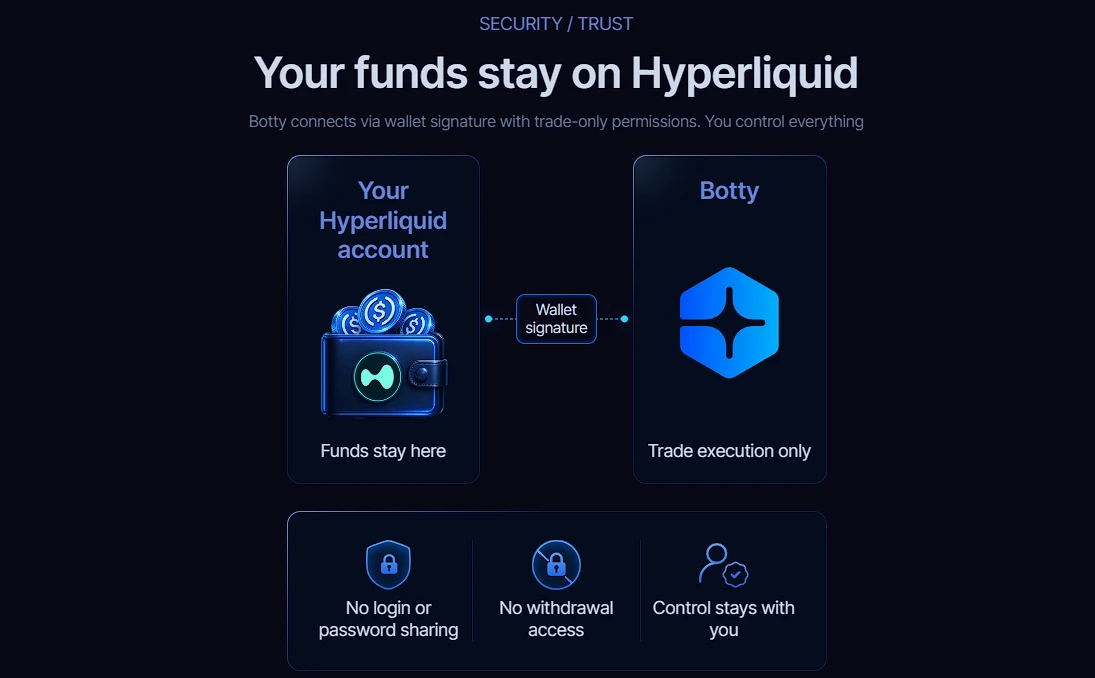
The connection uses Hyperliquid’s Builder Code mechanism. Botty receives trading-only permissions without withdrawal access, while funds remain on the user’s own exchange account. There is no mandatory monthly subscription; the platform uses an activity-based fee built into Hyperliquid’s trading fee.
A retired teacher recounts that a family member initially helped with the setup and that she became comfortable managing the bot independently after becoming familiar with the interface. Together with other accounts, this suggests that the setup can be relatively quick while the time needed to understand every setting may still vary between users.
Interface and Accessibility in Botty Reviews
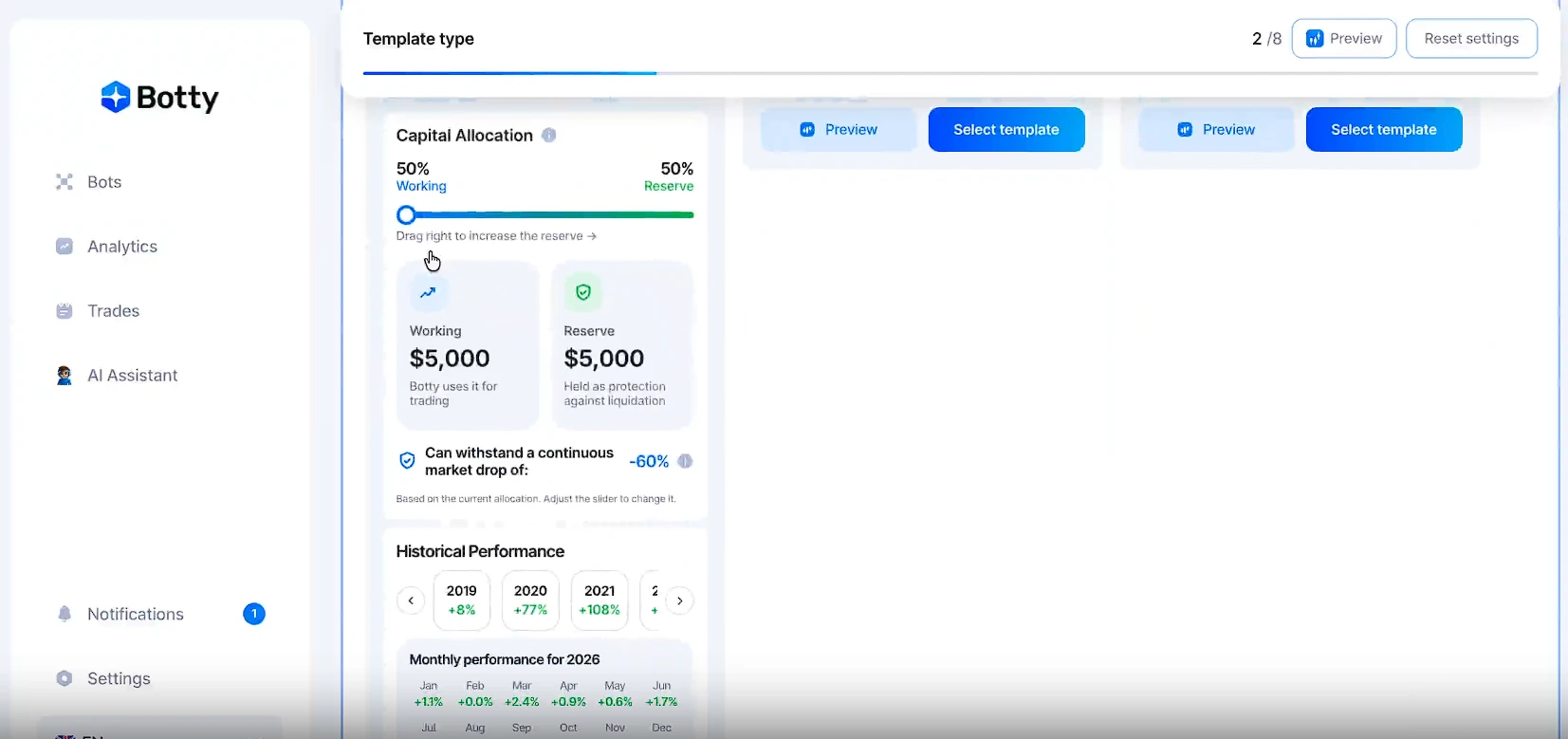
Closely tied to the initial setup is a cluster of reviews focused on the interface itself. The word that recurs most often here is “clean.” Reviewers with limited technical backgrounds repeatedly describe the layout and preset labels as easy to understand. One newcomer who “couldn’t tell a grid from a gridiron” says the presets and clear explanations helped them understand the available settings without an extensive trading background.
Mobile access is mentioned specifically by at least one reviewer, who describes checking the bot “from the bus” without needing to make changes, valuing the fact that everything needed is available on both phone and desktop. This lines up with the platform’s own description of itself as accessible from any device, though the review sample only lightly touches on mobile use, so it would be an overstatement to call this a dominant theme rather than a supporting one.
A retired teacher’s review deserves separate mention here, since it pushes back gently against the assumption that automated trading tools are only for younger, more technical audiences. She describes a family member helping her get started, then running the bot independently within a week. She says the interface is clean, the presets make sense, and the periodic summary is written in plain English. Together with the other accounts, this points to a modest but real pattern: reviewers across different demographics single out interface simplicity as a defining part of their experience.
Risk Controls: The Most Detailed Botty Reviews Focus Here
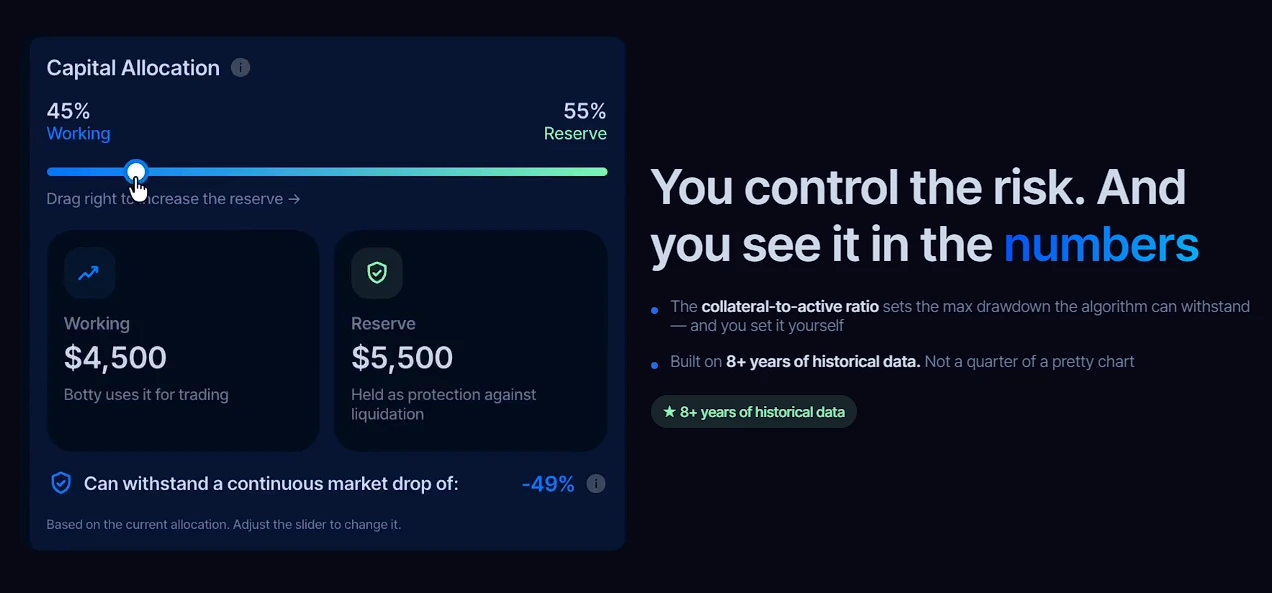
The most detailed reviews in the sample often focus on the built-in controls used by futures templates. Reviewers mention leverage limits, predefined position-sizing rules, and settings that prevent users from increasing exposure without restriction. One user describes running an SOL futures template during a volatile market week and highlights the role of the predefined parameters, while another specifically praises the leverage cap.
Botty’s futures templates use staggered order grids, capped leverage, partial-budget deployment, and predefined parameters. The platform offers conservative, balanced, and aggressive approaches, allowing users to choose a template according to their experience and preferred risk profile. Spot templates provide a more conservative alternative because they trade the underlying asset without leverage.
Botty Reviews and the Comparison to Copy-Trading
A smaller but distinct group of reviews compares Botty specifically to copy-trading, where a user’s trades automatically mirror those of another trader. One reviewer who had used copy-trading before describes it as feeling “like gambling on a stranger,” contrasting it with running their own settings, seeing every decision, and understanding why it happened, which they describe as far more control and far less blind faith. Another reviewer running two separate bots, a spot BTC bot and an ETH grid, says keeping them separate helps them see which style suits them and describes the transparency as superior to the copy-trading service they used previously.
This lines up with how the platform differs structurally from copy-trading: rather than mirroring one trader’s live signals across many accounts simultaneously, each user’s bot runs independently, with its own timing, settings, and trading pair. Whether that difference produces better outcomes than copy-trading in general is not something the review sample can answer, since none of the reviewers ran a controlled comparison. What the reviews do show is that several users experienced in copy-trading describe transparency and control as the main things that felt different, more than describing superior returns.

Fees and Transparency in the Reviews of Botty
Several reviewers comment specifically on the fee structure, and the reaction is consistently positive, though it is a smaller theme than automation or emotional discipline. Botty uses an activity-based fee model rather than a fixed monthly subscription. Its fee is built into Hyperliquid’s trading fee and applies when the bot actively executes trades. If the bot is idle, there is no Botty fee.
Transparency more broadly — seeing every trade and every statistic rather than trusting a black box—is mentioned across several reviews, sometimes tied to fees and sometimes to the non-custodial structure discussed below. One reviewer summarizes it simply: “every trade logged, every stat visible. No black box mystery here.”
Custody and Security: A Trust Signal That Recurs in Botty Reviews
A notable number of reviewers specifically mention that their funds never leave their own exchange account and that the bot only has permission to open and close trades rather than withdraw funds. One reviewer describes this as “the real dealbreaker, in the best way,” explaining that knowing Botty had no withdrawal access helped them feel more comfortable with the connection. Another simply states: “non-custodial or nothing, my coins never leave my own exchange.”
This non-custodial structure is a verifiable feature of how the platform connects through a wallet signature rather than holding client funds. Botty uses Hyperliquid’s Builder Code mechanism with trading-only permissions and no withdrawal access, with the restriction enforced at the exchange level. The permissions can be reviewed during the connection process.
Botty has also completed an independent security audit by DigVel, with information about the audit available on the platform’s website.
Reported Results in Botty Reviews: Modest, Not Miraculous
When it comes to actual reported outcomes, the tone across this sample is notably restrained. Reviewers describe “small, steady profits,” gains they will not “retire on,” and results explicitly framed as unremarkable but consistent. One reviewer writes plainly that “little profits stacking week after week” are “nothing I’ll retire on,” but frames consistency itself as the point, adding that they finally have “a system instead of vibes and hope.” Another describes six months of use as making them “a quiet believer, not because it’s magic but because it removed me as the problem,” rather than because of outsized returns.
The reviews in this sample do not provide standardized percentage results. The platform separately displays historical annual performance of approximately 7% to 58% for its ready-made templates, based on more than five years of backtesting data. These figures describe template history rather than user-reported outcomes.
What the Reviews of Botty Do Not Show
Within the independently sourced reviews collected for this analysis, no negative reviews happened to appear. That is worth stating clearly as a property of this particular sample, not as evidence that no negative experiences with the platform exist elsewhere and not as a claim that the company curated or selected these reviews. They were gathered from open, independent review platforms across three languages.
Within the sample, the closest thing to a critical comment comes from a review that otherwise reads positively: one user lists “dead simple setup, solid risk controls, transparent stats, fair fees” as strengths, then adds a limitation, wishing there were more trading pairs available while noting that BTC, ETH, and SOL cover their needs for now. This is consistent with the platform’s stated focus on a limited set of higher-liquidity, historically established assets rather than a broad altcoin selection.
The sample also does not represent every type of Botty user or every possible configuration. Where the available reviews are insufficient to establish a broader trend, it is more accurate to treat the comments as individual experiences rather than extrapolating them to the platform’s entire user base.

Frequently Asked Questions About Botty Reviews
Are the Botty reviews used in this article real user reviews?
Yes. The reviews referenced throughout this article come from an independently collected sample gathered from open review platforms across the internet in Ukrainian, Russian, and English. They were not supplied or curated by the company, and only the content of the reviews themselves was used in this analysis.
Do the reviews include any negative experiences with Botty?
Within this specific sample, no negative reviews appeared. That is a property of the particular collection analyzed here and should not be interpreted as proof that no negative experiences exist elsewhere, only as an honest description of what this sample contains.
What do users say most often in Botty reviews?
The most recurring theme is relief from emotional trading decisions, such as panic-selling during downturns or chasing rallies out of fear of missing out. A straightforward setup, a clean interface, built-in controls, AI guidance, transparent analytics, an activity-based fee model, and the non-custodial wallet connection are also frequently mentioned themes.
Do Botty reviews mention specific profit percentages?
No. The reviews in this sample describe results qualitatively, using terms such as “small,” “steady,” or “quiet,” rather than citing standardized return percentages. Botty separately displays historical annual results of approximately 7% to 58% for its ready-made templates, based on more than five years of backtesting data.
How does Botty connect to a user’s exchange account?
Botty connects through a wallet signature using Hyperliquid’s Builder Code mechanism. The platform receives trading-only permissions without withdrawal access, while funds remain on the user’s own exchange account.
Does Botty charge a monthly subscription?
No. Botty uses an activity-based fee model. Its fee is built into Hyperliquid’s trading fee and applies when the bot actively executes trades. If the bot is idle, there is no Botty fee.