


The first month with any trading bot is the highest-risk period, not because the market is unusually dangerous, but because the user’s understanding of the tool is at its lowest point. Botty user reviews from the first 30 days show a consistent pattern: the experience is almost entirely shaped by whether the user went in with accurate expectations and followed the capital rules before launching. Those who did tend to describe a manageable, educational process. Those who didn’t describe frustration, confusion, and in some cases, avoidable losses.
This article synthesizes what those reviews say, about starting capital, template selection, capital allocation rules, the typical emotional arc of week one, and the three mistakes that appear most consistently in negative first-month accounts.
What First-Month Reviews Focus On
First-month Botty reviews cluster around a handful of recurring themes. The most common is the experience of watching the bot open positions, seeing unrealized P&L go negative as the price dips, and not knowing whether this is normal behavior or a sign something has gone wrong. The second most common theme is confusion about which template to start with and how much capital to allocate. The third is the realization, sometimes pleasant, sometimes painful, that the platform’s onboarding materials contained information they wished they’d absorbed more carefully before launching.
The gap between positive and negative first-month reviews almost always comes down to preparation. Users who read the educational materials, understood the strategy mechanics, and set up their capital allocation correctly before launching report a very different experience than those who skipped steps or launched with incomplete understanding. This article is designed to close that gap before the first launch, not after.

How Much Capital to Start With — and Why It Matters
Starting capital affects the first-month experience in more ways than most new users expect. The obvious effect is that larger capital generates larger absolute returns from the same percentage gains. The less obvious effect is that starting capital determines which templates are practically viable and how much buffer the bot has to operate through market volatility without hitting constraints.
Botty’s fee tiers provide a useful framework for thinking about scale. The entry tier — 20% of realized profits, applies to accounts under $2,500 in active bot capital. At this level, the fee is higher, and the absolute profit from each closed cycle is smaller. A 0.8% gain on $1,000 in active positions is $8 before fees. After the 20% platform fee, it’s $6.40. This isn’t unworkable, but it means the compounding effect that makes this strategy compelling takes longer to become noticeable.
As capital scales up, the fee rate steps down: 15% at $2,500–$10,000, continuing to decrease at higher tiers. This means that starting with more capital, within whatever the user is genuinely comfortable with, improves the economics in two ways: larger absolute returns from the same percentage gains, and a lower fee rate reducing the drag on those returns.
The practical guidance from user reviews: start with an amount you’re genuinely comfortable leaving untouched for at least a few months, through both positive and negative unrealized P&L periods. Starting too small creates a mismatch between the strategy’s time horizon and the user’s patience. Starting with more than you’re emotionally comfortable with creates pressure to close positions at the wrong time.

Choosing the First Template: Spot, Futures, or All-Season
The template selection question generates more first-month review content than almost any other topic. The three main categories behave quite differently, and selecting the wrong one for the wrong user profile is one of the most common sources of early frustration.
Spot templates trade without leverage. The bot buys actual quantities of BTC, ETH, or SOL and holds them through the accumulation phase. There is no liquidation risk, the worst case is holding a position that is temporarily below the average entry price while waiting for recovery. For users who are new to automated trading, unfamiliar with how futures leverage works, or simply uncomfortable with the added risk of liquidation, spot templates are the appropriate starting point. Reviews from spot-only users consistently describe lower anxiety and a more educational first experience, even when the unrealized P&L dips.
Futures templates use leverage to amplify both potential returns and potential risk. The platform limits leverage to a maximum of 10x and requires maintaining a 50% cash reserve of the allocated budget. Even with these constraints, futures bots can face liquidation if the price drops past the liquidation threshold, approximately 34% below the BTC entry price and around 45% below ETH entry, when operated with the full 50% reserve. Without the reserve, those thresholds move significantly closer. First-month reviews that describe painful experiences with futures bots almost always involve one of two things: insufficient reserve capital, or a misunderstanding of what liquidation means and how to avoid it.
All-season templates are designed to function across different market conditions, bull, bear, and sideways, by operating within tighter parameters that sacrifice some upside potential in strong trends in exchange for greater resilience in unfavorable conditions. For users who are starting without a strong conviction about current market direction, or who want the most defensive starting point, all-season is the template that generates the most consistently calm first-month reviews. It’s not the most exciting option, but it’s the most forgiving one.

Capital Allocation Rules: Not Optional
Two capital management guidelines appear in Botty’s materials as recommendations but function in practice as requirements for managing risk responsibly. User reviews make clear that ignoring them is the most consistent predictor of negative outcomes.
The 50% reserve rule: for futures bots, only 50% of the total allocated budget should be in active bot positions. The other 50% stays in the account as reserve. This reserve is what allows the bot to continue operating through deep price drops without reaching the liquidation threshold. Users who deploy 100% of their capital in active futures positions are trading with essentially no buffer, a sustained adverse move can cause liquidation at a price level that wouldn’t have been reached with proper reserve in place. Every review that describes unexpected futures liquidation, on close examination, involves this rule being ignored.
The 80/20 portfolio split: the overall recommended allocation between spot and futures bots is 80% in spot and 20% in futures. This isn’t a rigid formula, but it reflects a sensible risk balance: spot bots provide the stability and no-liquidation-risk foundation, while futures bots contribute higher potential return with contained exposure. Users who invert this ratio, heavy futures, light spot, consistently report more volatile and emotionally demanding first months than those who maintain the recommended balance.

The Typical Week-One Experience
User reviews that describe the first week in detail show a remarkably consistent emotional arc, regardless of market conditions.
Days 1–3 typically involve a period of active engagement: watching the bot open its first orders, checking the unrealized P&L frequently, and feeling a combination of excitement and mild anxiety. If the price is moving favorably, some early cycles may close and produce the first realized profit, an experience that user reviews describe as disproportionately reinforcing relative to the actual dollar amount involved.
Days 4–7 often bring the first real test: a price dip that sends unrealized P&L negative. This is the moment that separates users who understood what they were launching from users who didn’t. Users who read the onboarding materials recognize this as the accumulation phase and observe it with interest. Users who skipped the materials describe this period as alarming, some report checking the bot every few minutes, and a meaningful number describe closing it manually during this phase, locking in the unrealized loss as a real one.
The first realized-profit cycle closure, when the price recovers and the bot closes a full series at a gain, is the event most commonly described in positive first-week reviews as the moment the strategy became concrete. Seeing the cycle complete end-to-end, from accumulation through recovery to realized profit, produces the understanding that no amount of explanation fully replicates.
Three Mistakes That Appear in Every Negative First-Month Review
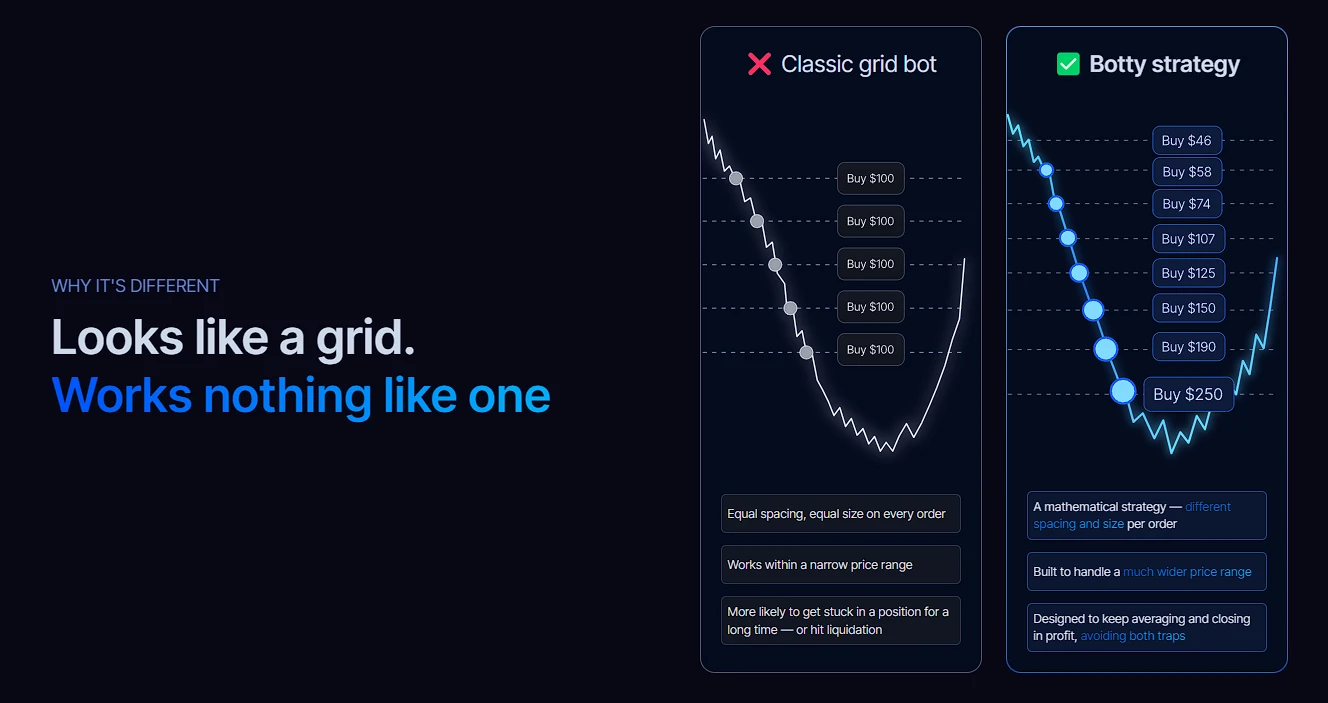
Mistake 1: Closing the bot during the accumulation phase. This is the most expensive and most preventable first-month mistake. The bot is in accumulation, unrealized P&L is negative, the price is below the average entry, and the user manually closes all positions. The unrealized loss becomes a real loss. The bot is relaunched later, often at a higher price, having locked in a loss at the worst possible moment. Every negative review that describes losing money in the first month, when examined closely, contains this sequence. The fix is simple: understand the accumulation phase before launching, not after.
Mistake 2: Launching a futures bot without the 50% reserve. Users who allocate their full budget to active futures positions are operating without the buffer that prevents early liquidation. When the market moves against them, which it will at some point, they hit the liquidation threshold at a price level that a properly capitalized bot would have survived. The psychological experience of liquidation in the first month is significantly more damaging than the financial loss alone: it produces a distorted view of the strategy’s actual risk profile.
Mistake 3: Evaluating the strategy based on one week or one market event. The grid-plus-averaging strategy is designed to perform over multiple market cycles, not over a single week or even a single month. Users who enter during a particularly quiet sideways period and conclude after two weeks that “the bot doesn’t work” are making a judgment based on one data point. Users who enter during a volatile period and see strong early results sometimes make the opposite error, assuming that rate of return is typical. Neither extreme is representative. The strategy’s value is in its behavior across different market conditions over time, not in any single snapshot.

What to Do Before Launching
The most consistent advice from experienced Botty users, when asked what they would tell someone starting for the first time, is almost always some version of the same list.
Complete the onboarding materials fully. Not skimming, not clicking through, reading and understanding the mechanics of the strategy, the capital rules, and what different types of P&L actually mean.
Decide on your template before looking at any numbers. The choice between spot, futures, and all-season should be based on your risk tolerance and understanding, not on which template shows the highest projected return in the backtest.
Set the capital allocation before launching. If running futures, set aside the 50% reserve before the bot is active. If running both spot and futures, establish the 80/20 split before either bot opens its first order.
Commit to a minimum observation period. Decide in advance that you will not make any structural changes to the bot for at least 4–6 weeks, through both positive and negative unrealized P&L periods. This commitment removes the ability to make impulsive decisions during the accumulation phase.
Verify your setup on the exchange, not just the platform. After launching, check your exchange account directly to confirm the bot’s orders are visible there. Everything the bot does is reflected on your exchange account, this is both a security feature and a transparency one.
What the First Month Actually Tells You
The first month with Botty is primarily informational. It tells you how the strategy behaves in the current market environment, whether your capital allocation is appropriate for your emotional comfort level, and whether your expectations were calibrated correctly.
It rarely tells you definitively whether the strategy will be profitable over a meaningful time horizon. A good first month in a volatile, recovering market can make the strategy look extraordinary. A quiet first month in a sideways market can make it look underwhelming. Neither reading is accurate as a long-term assessment.
What user reviews from people who stayed past the first month consistently show is that the experience stabilizes. The anxiety about unrealized P&L decreases as the accumulation-and-recovery cycle becomes familiar. The temptation to intervene manually diminishes as the pattern repeats. The question shifts from “is this working?” to “how do I optimize for different market conditions?”, which is a very different, and much more productive, place to be.
Cryptocurrency trading involves significant risk. Past performance data does not guarantee similar results in the future. Potential returns depend on market conditions, selected settings, and capital management practices.