

Table of Contents
- Introduction to SD-WAN
- Key Benefits of SD-WAN
- SD-WAN and Cloud Integration
- Enhancing Security with SD-WAN
- Cost Efficiency and Performance Improvements
- Real-World Applications of SD-WAN
- Future Trends in SD-WAN
- Conclusion
Businesses around the world are undergoing rapid transformation as digital technology evolves. New frameworks and solutions are sought after to optimize network infrastructure, improve agility, and maximize performance. Among the most notable advancements is Software-Defined Wide Area Networking (SD-WAN), a technology that is fundamentally redefining how organizations connect, manage, and secure their operations. For companies seeking improved flexibility and reliability, enterprise SD-WAN solutions present a highly effective approach to managing distributed networks at scale.
As digital services continue to spread and cloud platforms become the backbone of everyday business, traditional WAN architectures often struggle to keep up with traffic demands and new security requirements. SD-WAN helps overcome these limitations by abstracting network management away from siloed hardware, making it easier to maintain robust connectivity between data centers, branch offices, and remote employees. By adopting this approach, businesses can not only stay ahead of technological shifts but also enhance user experience and maximize ROI.
Integrated with intelligent traffic routing, security, and cloud optimization functions, SD-WAN enables organizations to meet rising expectations for speed, security, and reliability. Companies that implement modern SD-WAN architectures also benefit from simplified operations and can respond more swiftly to networking issues, promoting stronger business continuity even in a fast-changing landscape. The growing reliance on networks to deliver productivity, real-time communication, and collaboration solutions further highlights SD-WAN’s pivotal role in the digital enterprise.
For a deeper understanding of the foundational concepts and how SD-WAN fits within broader business networking trends, reputable resources such as Network World offer valuable insights for IT leaders and decision-makers.
Introduction to SD-WAN
SD-WAN simplifies the orchestration and operation of wide-area networks by separating the hardware components from the central control function. This decoupling allows IT teams to quickly implement changes, adjust traffic priorities, and scale their networks without being constrained by physical infrastructure. Modern SD-WAN platforms support policy-driven management, enabling intuitive alignment of networking with business objectives.
Key Benefits of SD-WAN
- Centralized Control: Network administrators can define rules and policies from a single interface, ensuring policy consistency and a uniform experience across all sites. Updates and patches can be deployed seamlessly to the entire network.
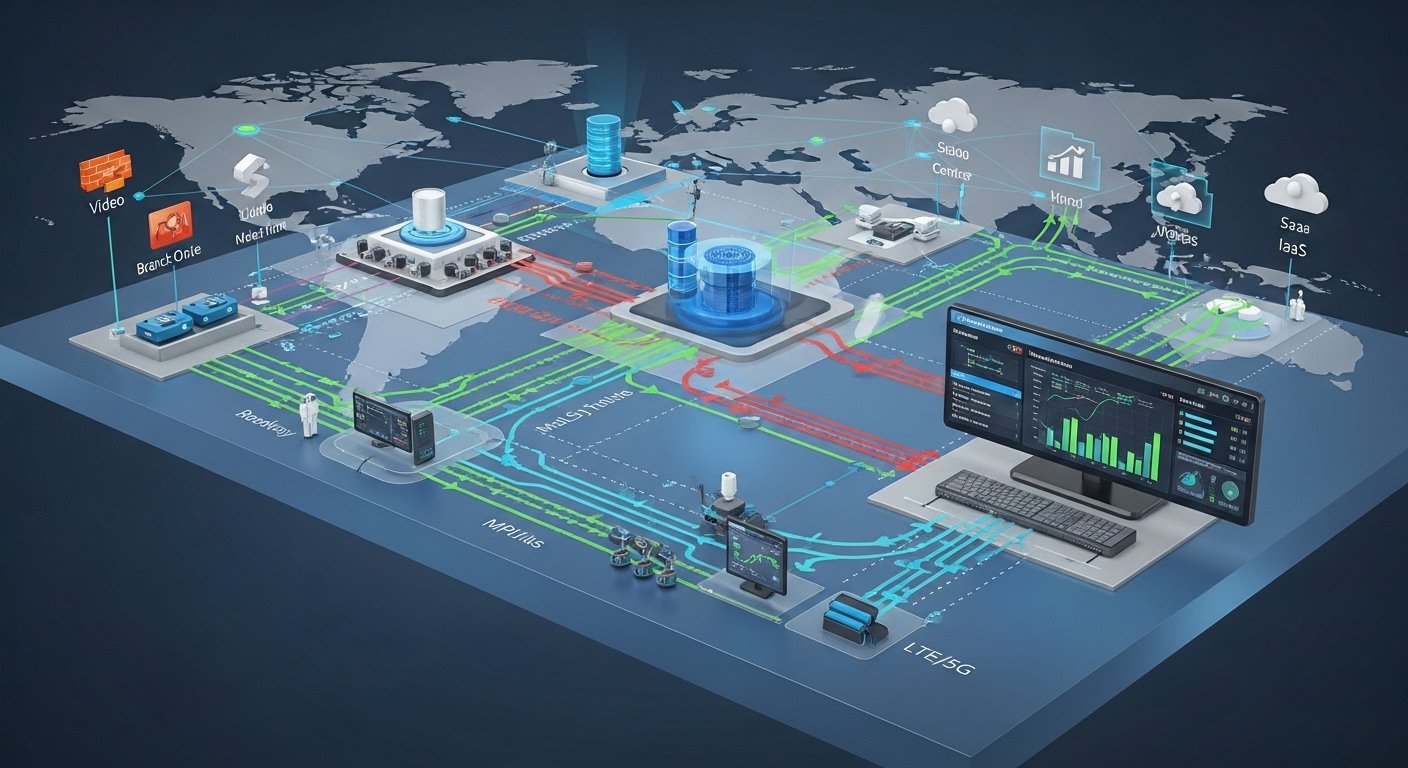
- Hybrid Connectivity: SD-WAN supports a combination of transport mediums, including MPLS, broadband, LTE, and 5G, which offers redundancy and more efficient use of network resources. Dynamic path selection ensures that critical business applications always receive priority bandwidth and the lowest-latency routes.
- Integrated Security: Many SD-WAN platforms offer a full suite of embedded security features. Solutions supporting Secure Access Service Edge (SASE) unify networking and security into one framework, making it easier to enforce policies organization-wide. This is particularly beneficial for organizations with rapidly expanding remote workforces.
SD-WAN and Cloud Integration
Companies that rely on cloud-based platforms such as Microsoft 365 and Salesforce need network solutions that offer high performance, reliability, and security, requirements that traditional WAN architectures often struggle to meet. SD-WAN (Software-Defined Wide Area Networking) addresses these challenges by creating direct cloud on-ramps, reducing the number of intermediary network hops, lowering latency, and improving application responsiveness. This approach ensures a smoother, faster experience for users accessing SaaS and other cloud services. Additionally, SD-WAN easily integrates with multi-cloud environments, providing centralized management, traffic prioritization, and enhanced security, making it an essential tool for enterprises seeking scalable, efficient, and future-ready network infrastructure.
Enhancing Security with SD-WAN
The security landscape is evolving along with connectivity requirements. SD-WAN incorporates capabilities such as end-to-end encryption, firewalls, intrusion prevention, and support for zero-trust network access. These features are crucial as businesses extend their networks across remote sites, IoT deployments, and cloud environments, making it easier to maintain security best practices without managing multiple, disconnected tools. Trusted IT publications such as CSO Online provide detailed analysis of SD-WAN’s evolving security features and their impact on enterprise IT.
Cost Efficiency and Performance Improvements
One significant advantage of SD-WAN is its ability to lower networking costs by leveraging more affordable transport options such as public broadband and LTE. Traditional MPLS lines can be reserved for only the most latency-sensitive applications to maximize cost efficiency. Additionally, application-aware routing ensures mission-critical traffic is always prioritized, supporting activities like VoIP, video conferencing, and digital collaboration with reliable performance and minimal downtime.
Real-World Applications of SD-WAN
DHL implemented SD-WAN across more than 3,000 facilities, resulting in a 35 percent decrease in application downtime and more effective coordination across international logistics hubs. In the energy sector, NTPC integrated SD-WAN with IoT at its power plants to enable secure, real-time energy monitoring, reducing incident response times by over 40 percent. These real-world deployments underscore the technology’s adaptability and effectiveness across industries as diverse as logistics, manufacturing, healthcare, and retail.
Future Trends in SD-WAN
Market research indicates the SD-WAN market is poised for significant growth, with projections that it will more than double in size between 2023 and 2028. This expansion is largely driven by organizations embracing digital-first strategies and seeking to modernize their network infrastructure for improved agility and performance. The integration of SD-WAN with Secure Access Service Edge (SASE) is expected to provide a unified platform that combines networking and security, streamlining management and supporting regulatory compliance. Additionally, advancements in automation, analytics, and AI-driven tools will enable IT teams to proactively optimize network performance, anticipate potential issues, and mitigate security risks more efficiently. These trends position SD-WAN as a central component of future-ready enterprise networks.
Conclusion
SD-WAN has emerged as a game-changer in enterprise networking, providing businesses with flexible, reliable, and secure connectivity across multiple locations. By centralizing network management, organizations gain greater visibility and control over traffic, simplifying operations while reducing reliance on costly traditional infrastructure. Its hybrid connectivity capabilities allow seamless integration of broadband, MPLS, and LTE links, ensuring uninterrupted performance even under heavy workloads. Advanced security features, including encryption and segmentation, protect sensitive data across distributed environments. Additionally, SD-WAN offers significant cost savings compared with conventional WAN architectures. As more companies adopt cloud-first strategies, SD-WAN becomes critical for supporting agile operations, optimizing application performance, and maintaining a competitive advantage in an increasingly fast-paced, digital-driven marketplace.